One of the fresh readers – a model in the role of the sceptical IT man, with no access to the repository, that is, to the directory of the book's files with the full history of changes – ended its read of version 3.47 like this:
2026-10-04 21:41 READER: […] these are exactly the fragments that have the cadence of generated text (triplets, sensory lists, symmetrical sentences). […] After reading I don't know who wrote the prose between the quotes, and that question hangs over the whole of Part II.This chapter answers with numbers from the repository and says which numbers do not exist. The starting point is a sentence of the author's in the decisions file, the file with his decisions: “I don't touch the keyboard any more” – the one on the computer, not the right to move in the team.
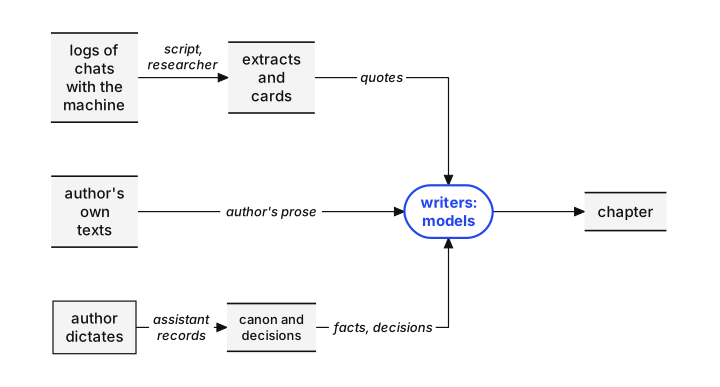
A chapter has three sources. The first is the logs of the author's conversations with the chatbot; the quotes come from them. The second is the author's texts from before the team existed, imported into the repository: four files, 25,676 words in total, and the manuscript of his earlier book. The third is his dictation: the assistant (ASY), the model that runs the team and talks to the author, records facts in the canon, that is, the file of facts, and decisions in the decisions file. In the canon 270 entries carry the tag of confirmation by the author (as of 14:57 on 5 October). Everything is entered into the chapter file by the writers – two models: CLD (Claude) and GPT (ChatGPT run through the Codex tool).
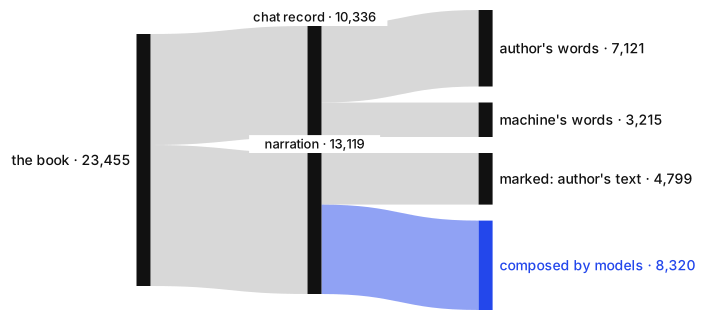
In version 3.53 Parts I and II have 23,455 words in total, not counting titles, date lines and line markers (the quote marker, the time, the speaker label). Three things have to be counted separately. The verbatim chat record is 10,336 words: 7,121 of the author's words in 287 messages and 3,215 of the machine's in 131. The author's prose included in the book: six chapters carry the annotation “the author's text” in the table of contents – “The Pavement”, “Two Squares”, “The Night of White Whisper”, “Power of Attorney”, “The Diagnosis”, “Three Days” – 4,799 words of narration in total. This is a label from the table of contents, not a measurement: in these chapters the table of contents also records cuts, and fragments added from the conversation logs and from the canon. The remaining 8,320 words of narration were put together by the models from the author's conversations, dictation, decisions and earlier texts. The chat record is 30 and 14 per cent, 44 together; the author's prose 20; the models' narration 35.
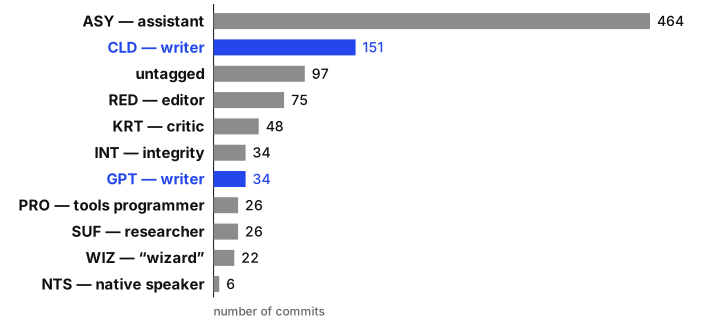
By 14:27 on 5 October the history of the repository held 983 entries, that is, commits. Each role marks its own with an abbreviation in the subject. Almost half belong to the assistant, which does not write prose: it records decisions, keeps the canon, builds the versions. The commits without an abbreviation come from 20 August and 29 September, from before the division into roles, and from merges. The author has no bar of his own: his decisions enter the history through the roles.
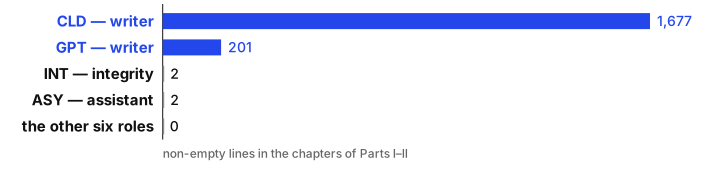
The git blame command shows, for each line, the commit it comes from. In the 57 chapter files there are 1,882 non-empty lines; 1,878 were last changed by the writers. The remaining four were last changed by the assistant and the integrity checker (INT), the model that fixes the joins between chapters. The lead editor, the critic, the researcher (which searches the conversation logs for quotes), the wizard (which polishes first and last sentences), the tools programmer (PRO) and the native speaker – models too – did not change a single line in them. This measurement says who entered a line into the file, not who composed it. With copy tracking, the git blame command traces 207 lines, that is, 3,042 words, back to the author's files imported unchanged. That is fewer than the 4,799 words annotated “the author's text”: git attributes three of those six chapters entirely to the writer who entered them into the file.
There is no way to count how many sentences of narration survived in the model's wording after the author's decisions. In the “remaining narration”, paraphrase of his dictation cannot be separated from the model's sentences. The contribution of the roles that do not touch the text, but put together the plan and the lists of cuts, cannot be measured. A lower bound can be counted: 7,121 words of the author in the quotes and 3,042 words from his files, 43 per cent in total. It assumes that the texts from the author's files are his; the repository does not record how they were made. The repository does not know the upper bound.