In Parts I and II, 44 per cent of the words are quotes: the record of the hero's conversations with the chatbot (version 3.53 of 5 October; only the words of the messages are counted, not the times or the speaker labels). Each such line has a time, a speaker and content. Each of these three elements is checked by a separate script, which compares it with the logs, that is, with the records of the conversations exported from the author's account. This chapter shows the path of one line from the export to the page.
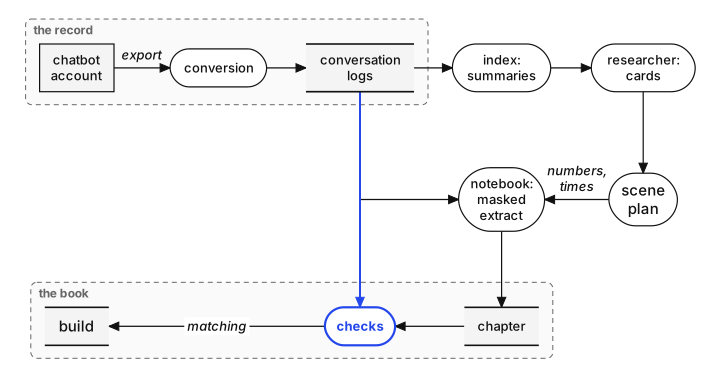
The author downloaded the full export of the conversations from his account. The tools programmer (PRO, a model) turned it into text logs, one file per conversation; the last one is numbered 3884 and dated 29 September 2026. Nobody reads all of this when writing. Models summarised the conversations in the index, the researcher (SUF, a model) picked cards from them – notes on one subject, with word-for-word quotes and conversation numbers – and the lead editor (RED, a model) entered conversation numbers and times in the scene plan. The writer gets a notebook: a short extract of word-for-word exchanges in which a script has masked names, telephone numbers and addresses. There are 24 notebooks. The checks compare the finished chapter not with the notebook but with the full logs; that is the highlighted line.
A quote line in a chapter file looks like this:
> 02:02 ME: Go on, other solutions.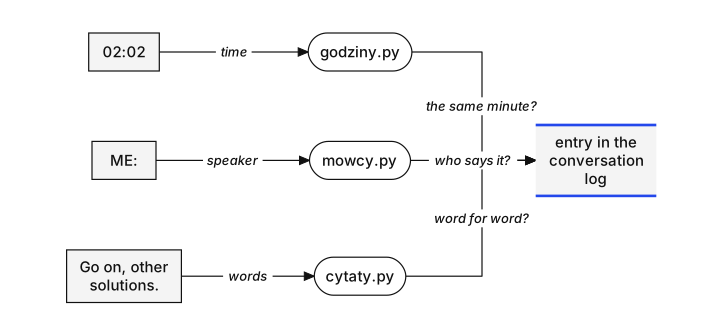
The script godziny.py looks in the log for an entry by the same speaker that contains the beginning of this text, and compares the time. The script mowcy.py establishes whether the sentence appears in the log under “ME:” or under “GPT:”. The script cytaty.py splits the quote at each cut mark […] and looks for each fragment in the full log. In version 2.32 of 2 October it checked 1,112 fragments; none failed to match. It checked 622 timestamps then; all matched.
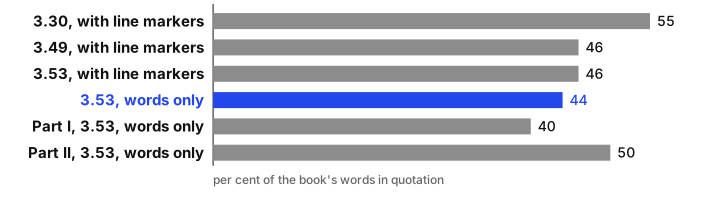
The share is counted by the team's script, separately in each chapter. It also counts the line markers as words of the quote: the quote marker, the time and the speaker label. By this measure, on the morning of 4 October, in version 3.30, the chat record made up 55 per cent of the book. That day the lead editor set a target: a continuous block of quotes up to around 150 words, a chapter below around 65 per cent, the whole 45–48 per cent. In the evening, in version 3.49, it was 46 per cent, and it is the same in version 3.53. Without the line markers, version 3.53 has 23,455 words, of which 7,121 are the author's words in quotes (30 per cent) and 3,215 the machine's words (14 per cent); together 44 per cent. Without the markers Part I is 40 per cent quotes, Part II 50.
The faithfulness of a quote has one exception. It arose on the afternoon of 4 October, when the author was looking at a page with his own sentence, once dictated to the chatbot by voice and garbled by speech recognition. The window is a reconstruction from the record of the author's conversation with the assistant (ASY) – the model that runs the team and talks to the author – abridged, with cuts marked […].
2026-10-04 16:44 AUTHOR: [you messed it up], he says ... (come on fix obvious errors of this kind, they add nothing and only spoil things, go through all the quotes once more)
16:46 ASY: accepted and recorded as a new rule (417cb61): we correct obvious speech-recognition errors in your messages without brackets; we don't touch the machine's words. […] One question about this particular sentence. The log has “[you messed it up] you say she'd rather in the morning”, you wrote “[you messed it up], he says…”. Which wording is to go in?
16:46 AUTHOR: [you messed it up], she says ...
16:47 ASY: recorded (05095fa), in the canon and in the decisions. The book will have: “[You messed it up], she says she'd rather in the morning, come on, rescue the situation.”
16:50 AUTHOR: go ahead, I'm very curious how it came out :)
The rule recorded that day at 16:45: obvious speech-recognition errors in the author's messages are corrected without square brackets, and the machine's messages are not touched.