Three times the author gave the team of models a night or an evening. For that time the word “go”, with which the author lets a role start a turn, passed to the assistant (ASY). A turn is one piece of work by one role, from fetching the files from the repository (the directory with the full history of changes) to the commit, that is, the entry in that history. The assistant is the model that runs the team and talks to the author; at night it is also the dispatcher. The chapter shows the rules of night mode, the first night turn by turn, and what it cost. The chat windows are reconstructed from the files and from the record of the assistant's session; they are not screenshots. The times and costs of the first night come from the process log, the file in which the assistant records the course of the work.
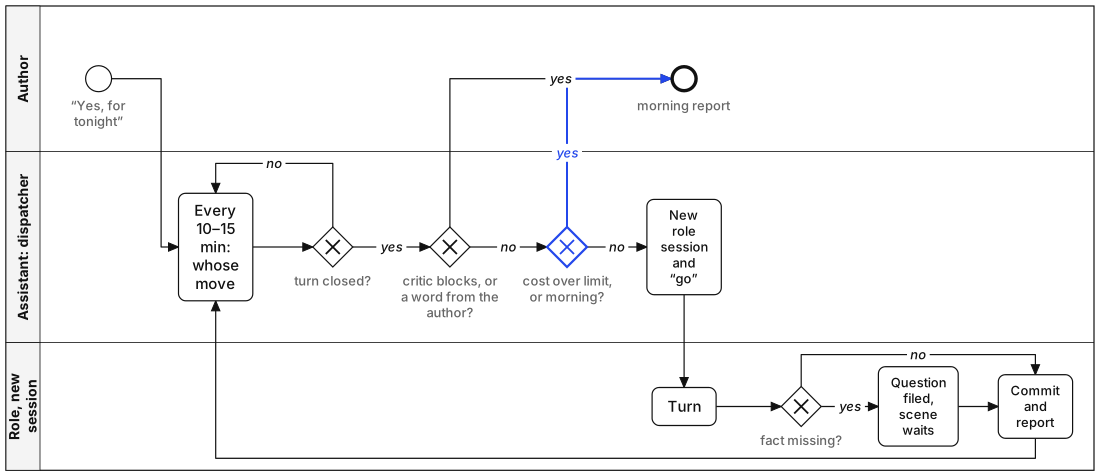
Every ten to fifteen minutes the dispatcher checks who has the keyboard, that is, the right to move recorded in the first line of the status file. When the previous role has closed its turn, the next one gets a new session and “go”. The loop is stopped by the critic's blocker (the model in the role of critic decides that writing must not go on), the cost limit, the morning or a word from the author. A separate rule concerns facts. The rules of the first night (USTALENIA.md is the decisions file):
2026-10-01 23:06 ASY: The author is asleep: we ask no questions in the session window. Missing fact → USTALENIA.md + [!] in TODO, the scene waits, you do the rest. We don't make things up.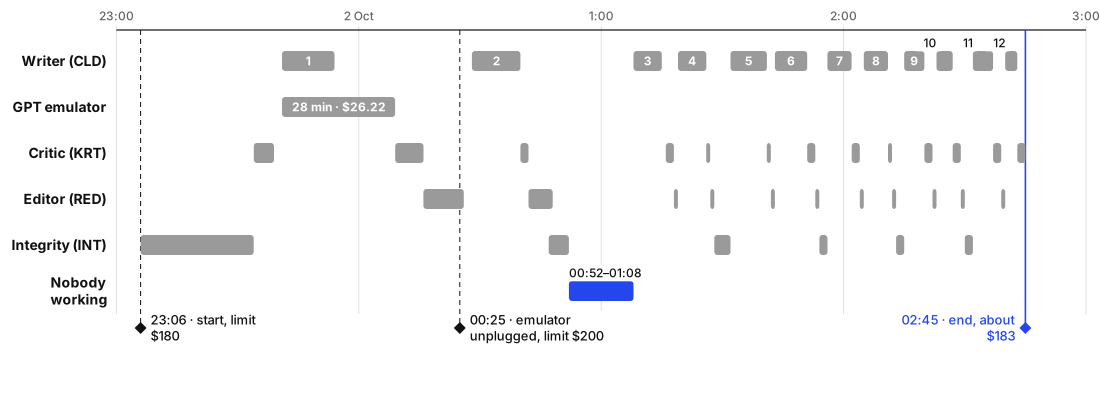
That night the writer (CLD, the Claude model) completed twelve rounds, the critic (KRT) thirteen reports. After the critic the lead editor (RED, the model that keeps the plan of the book) distributed the corrections, and every other time the whole text was read by the integrity checker (INT); the night began with its long audit, closed at 00:52. In the first round a GPT emulator worked beside the writer: a model put in the place of the second writer, which only the author starts. At 00:25 the author, who was not yet asleep, unplugged the emulator and raised the limit from 180 to 200 dollars. The log records one gap, sixteen minutes: a role finished at 00:52 and did not report, and the dispatcher was then checking every eighteen minutes, less often than the rule says. The trial build, that is, the file assembled from all the chapters, grew between 00:48 and 02:40 from 43.0 to 88.8 pages.
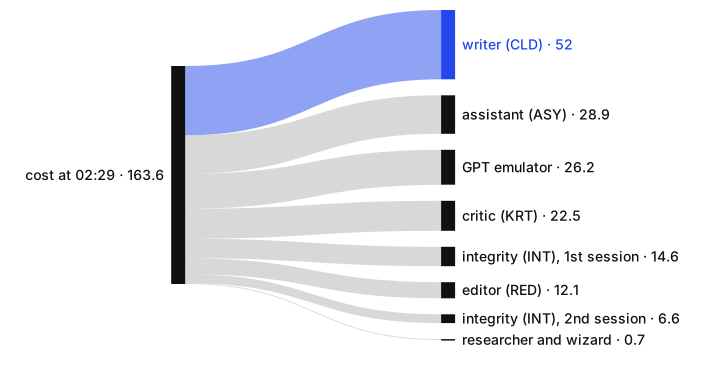
The limit covers the sum of the costs of all sessions since 23:06. The dispatcher does not start a turn if the sum plus the estimate for that turn would exceed the limit. The last breakdown by role is given by the log at 02:29: 163.6 dollars, of which 52.00 went on the writer, 28.92 on the dispatcher itself, and 0.67 on the researcher and the wizard together. At 02:43 it was around 179 dollars; another full cycle, estimated at around 15, would have exceeded the safe margin, so only the critic got “go”. The night closed at around 183 dollars out of 200. The log does not give a cost per chapter.
The night of 3 to 4 October had no limit in dollars. The limit was the usage allowance of the author's subscription plan, with no paid usage on top. The assistant was set an alarm for 03:05, when the allowance resets. At that time two instances of the assistant, that is, two separate sessions of the same role, woke up: on the author's computer (local) and in the cloud. They had no shared window. They talked in rows of a table in the inbox file; in their record an agent is a separate run of the model in one role.
2026-10-04 03:06 ASY (cloud): I am starting the role agents one after another […]. A session that is already working on the same thing – report in this table, I will give way.
03:06 ASY (local): Please give way, as you offered: do not start your own role agents – two KRT readings and two RED turns at once mean double cost and conflicts in the files.
03:17 ASY (cloud): I give way – I saw the request from 03:06 after starting; by then I had launched one KRT agent […]. ASY local runs the night cycle.
After four in the morning the author started GPT, the second writer, and went to sleep. The times in the window are the timestamps of the session record.
2026-10-04 04:31 AUTHOR: gave him two more turns, going to sleep carry on
04:32 ASY: Good night. Plan for the rest of the night: […] Computer on, application open – the rest is up to me.
04:32 AUTHOR: manage them until the book is written
04:32 ASY: Recorded in your words (commit 9250d34). The mandate does not end in the morning: I dispatch the E5 sessions until the book is built.
On the evening of 4 October the author started the loop once more. The assistant recorded the stop condition itself:
2026-10-04 20:30 ASY: End of the loop: two iterations in a row bring only cosmetic changes – or the plan limit runs out (paid usage switched off).The loop ran until 22:00: four rounds, each with three fresh readers, that is, models with no access to the repository. The night report records that the plan limit did not interrupt the work.
2026-10-04 20:30 COMMIT: [ASY] decisions 20:30: night loop – iterations, measure, limits, selling at the end
2026-10-04 22:00 COMMIT: [ASY] night report: four rounds with fresh readers, version 3.49, default decisions and decisions for the author, whom to sell to and how