The people from the author's life have different names in the book than in life. This is enforced not by the models' memory but by one table and one script. The table sets the real form next to the form used in the book. It is the only place in the repository where the two stand side by side; the file has the words “NOT FOR PUBLICATION” in its header. No real name from that table appears in Part III.
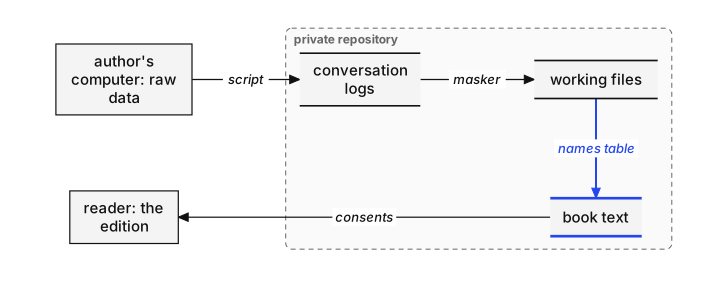
The data passes through five zones – the three middle ones are in the private repository – and each boundary stops something. The full export of the conversations, the original photographs and the recordings stay on the author's computer. The conversation logs with the real names go into the private repository. The masker – the script that prepares extracts from the conversations for the writing models – replaces names, telephone numbers, e-mail addresses and postal addresses with words in brackets. A name enters the text of the book only in the form given in the table. An edition leaves the repository after the consent of Kasia, the hero's wife, the lawyer's opinion and the author's decision.
The checking script runs before every write to the repository's history, that is, before every commit. This rule has a date. The assistant (ASY) – the model that runs the team and talks to the author – recorded in the process log, that is, in the file in which the team notes errors and rules, after the author's account name had appeared in the README file:
2026-10-01 19:33 ASY: commit of README 19:30 without sprawdz.sh – the account name in the README broke anonymity […]. Fix: sprawdz.sh before every commit, one-line ones too.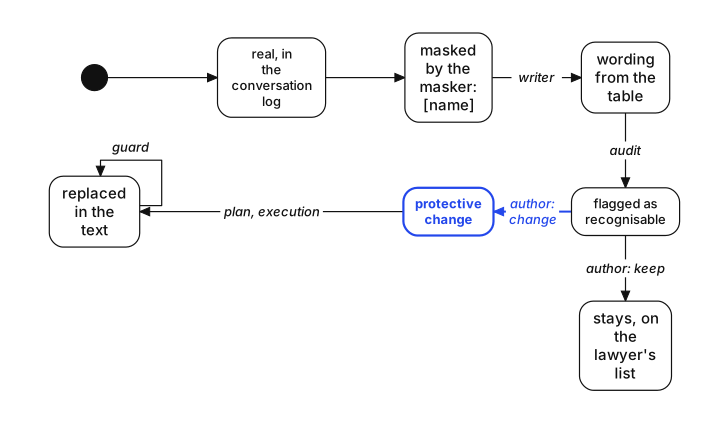
A name from a conversation log does not go into a chapter directly. In the extract it is already a bracketed word; the writer puts in the form from the right-hand column of the table, and in a quote from a conversation encloses it in square brackets, so that the substituted word does not pass for a word from the log. A separate audit looks for details by which a person could be recognised despite the changed name: names of things, dates, times. The author decides on each one. A changed detail gets a row in a second table, “was → is”, and a guard in the checking script stops the commit when the old wording comes back into the book. Above the second table is this sentence:
These are **deliberate inventions** – not facts: `FAKTY.md` stays true, and in conversations with the author and in the canon we use the left column.So the canon, that is, the file of facts, stays true, and the book departs from it only where the second table says. The decision on the scope of the changes was made on 4 October in one sentence, the answer to five “yes or no” questions; the time comes from the decisions file, in which the assistant records the author's decisions.
2026-10-04 13:55 AUTHOR: yes, we detach us as much as it can possibly be done, so that it can't be connected2026-10-04 13:55 COMMIT: [ASY] the author's decision: protection of the people in the book – all five “yes”, we detach the author and those close to him as much as it can possibly be done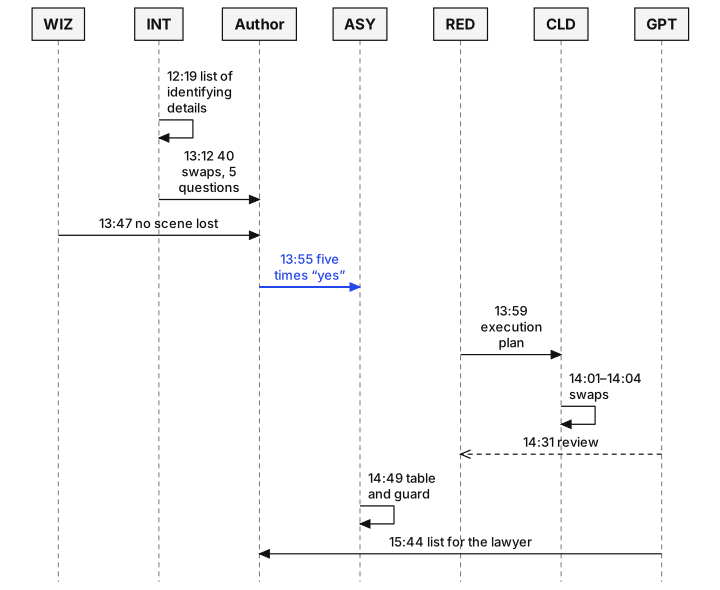
From the first list to the list for the lawyer, three hours and twenty-five minutes passed. All the roles apart from the author are models. The integrity checker (INT) listed the identifying features and proposed forty replacements with five “yes or no” questions. The wizard (WIZ) rewrote the proposal so that the author's five “yes” answers would not cost a single scene. The lead editor (RED) drew up the plan four minutes after the decision; the writer (CLD) carried it out in five minutes. The second writer (GPT) read the result as an outsider, and then drew up a list of 78 items for the lawyer – “without legal assessment”. The assistant added the second table and the guard.