A stop is a place where the reader breaks off reading because they do not understand something: they do not know who is speaking, who is being spoken about, or two sentences contradict each other. The reader here is a language model that gets the built book with no knowledge of the project and lists the places where it stopped. The word “staje” (“stops”) was used in a report by the assistant – the model in the role of ASY, which records the author's decisions and hands out the work. The author asked what it meant. The window was reconstructed from the record of the author's conversation with the assistant and from the decisions file.
2026-10-05 13:58 AUTHOR: in “The Medal” you can't tell who says “All right. Then one more candle. For my mother. If that's how it is.” - that's me saying it, it's quite important
13:58 AUTHOR: what does it mean that the reader stops?
14:03 ASY: “The reader stops” – that is my imprecise shorthand. It means a place where the reader breaks off reading because they do not understand something: they do not know who is speaking, who is being spoken about, or two sentences contradict each other. Their eyes then go back, they read it again and for a moment they drop out of the story.
14:25 AUTHOR: The reader must not stop, locate those places where they stop and give them what is needed there so they don't stop, if it's a matter of translation and it causes a discrepancy then a register of places of this kind has to be kept, why there is a divergence, the difference described quoted in the text in Polish, in the target language. Get it? Work out first the format of such a file, how it would work, how to use it and what for; the workflow has to be changed too. Into the file: enter those places where they stop, why, how to resolve it and why this way, the resolution.
14:30 ASY: The register of stops is set up, and the work […] on Part III has started – I am now waiting for five parallel tasks […]
At 14:25 the author sent two messages – this one and the order for Part III. The correction that followed the 13:58 message and the carrying out of the 14:25 order are in the history of the repository, that is, the directory of the book's files in which every change leaves a record (a commit):
2026-10-05 14:02 COMMIT: [ASY] 3.52 / 3.52en: “The Medal” – author: “that's me saying it” (canon, then text: “— Dobra — mówię.” / “— All right, I say.”); translation memory, build of both languages (text), report
2026-10-05 14:27 COMMIT: [ASY] register of stops and divergences: POSTOJE.md (format, use, change of process), check przeklad.py postoje, PROCES §13; the author's decisions of 13:58 and 14:25 (the reader must not stop; Part III)
The register is one file. Every entry has a permanent number and one of four states:
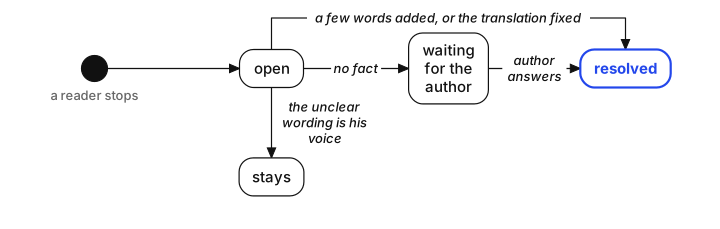
There is no final state: entries are not deleted, the state is changed. Three paths lead out of the open state. When the missing information is in the canon, that is, in the file of facts, the writing model supplies it as briefly as possible: in a word, in half a sentence. When it is neither in the canon nor in the conversation logs, the entry waits for the author with a question ready and nobody fills in the gap. When the lack of clarity is the hero's way of speaking, the entry gets the state “stays”, with the reason – the next reader will report the same thing and will find the decision. A turn, that is, one piece of work by one role, is not closed as long as there is an open entry in the register.
The first entry of the register in full, as it stood at 15:30:
### P-001 · 2-11-medal.md · who says the line about the second candle
- state: resolved
- where: source
- reported by: read straight through, Part II (B, the strongest stop); editor of batch 3; check of the last changes (9)
- why the reader stops: after “He smiles. I smile too.” comes a line with no speaker; the reader does not know whether it is the master or the hero who adds the second candle, so they do not understand the joke in the next sentence
- what is needed: naming the speaker
- resolution: “mówię” (“I say”) added (version 3.52), in both languages
- why this way: author, 2026-10-05 13:58: “that's me saying it, it's quite important”; one word, with no change to the content of the line
- divergence: no
- pl: „— Dobra — mówię. — To jeszcze jedna świeca. Dla matki. Skoro tak.”
- en: “— All right, I say. Then one more candle. For my mother. If that's how it is.”Here the reader stopped in the Polish text, so the Polish text was corrected and the translation followed it. Both languages say the same thing and the field “divergence” has the value “no”.
It is different when only the reader of the translation stops. The Polish “hale” (large halls, industrial buildings) does not say what the buildings are for. The earlier English “sheds” was understood by an American reader, also a model, as garden sheds. The translation chose one of the two meanings given by the author and from then on says more than the original. Such a difference is a divergence. It stays in the register with both quotes, so that the next translation turn does not undo it. From entry P-008:
### P-008 · 1-05-trzy-miliony.md · “hale” (also “hala za lasem”, “the hall beyond the woods”, in 1-11-prawo-weta.md)
- where: en
- divergence: the Polish “hale” does not say what they are for; the English “warehouses” picks one of the two meanings given by the author (warehouses, not data centres), because English has no equally general word that does not mislead.
- pl: „Hale. Ogromne hale między domami, pod lasem, u nas.”
- en: “Warehouses. Enormous warehouses between the houses, by the woods, where we live.”
On 5 October at 15:30 there were 86 entries in the register. Fifty-three were resolved, 38 of them concerning the translation only; 18 were waiting for the author, 15 had the state “stays”, none was open. A divergence was described in 23 entries. The check of the register, a separate script, reported two warnings: two entries without the field “why this way”. The state recorded at 14:50 had 50 resolved and two open. At 15:03 four reports went into the repository from a read of version 3.53 that models did solely to list the stops: 51 and 54 stops reported in the Polish Parts I and II, 35 and 46 in the English. At 15:30 they had not yet been carried over into the register. The measure is the number of stops per ten pages. The read loop ends when a new reader reports nothing apart from entries that stay or are waiting for the author.