The book was made the way a proof of concept is made in computing: an attempt, an assessment, the next attempt. The repository was set up on 20 August 2026: the canon of facts, the text and the checking script. By 14:27 on 5 October it held 983 commits, that is, entries in the history of changes; all the figures in this chapter are as of that time. All the commits fall on eight days. Between the first and the second of those days there are 39 days without a single entry.
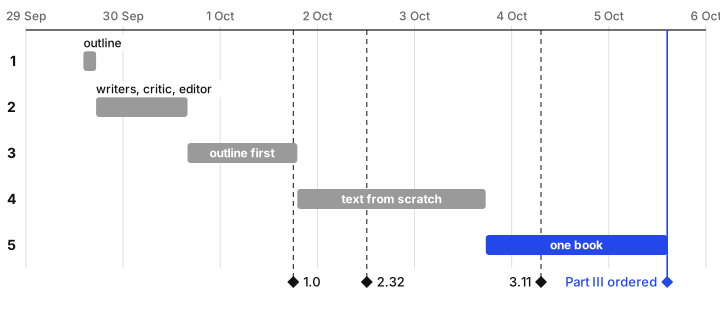
From 29 September on, the team started the book five times. Each attempt, called an experiment in the repository, has its own directory; the earlier ones stay as an archive. The first lasted about three hours, the fifth is still going. The author listened to version 1.0, the result of the third attempt, on 1 October at 18:03 and an hour later the fourth attempt began. Version 2.32 of 2 October is the result of the fourth. Version 3.11 of 4 October, 07:15, is the complete working draft of the fifth, built after a night of writing.
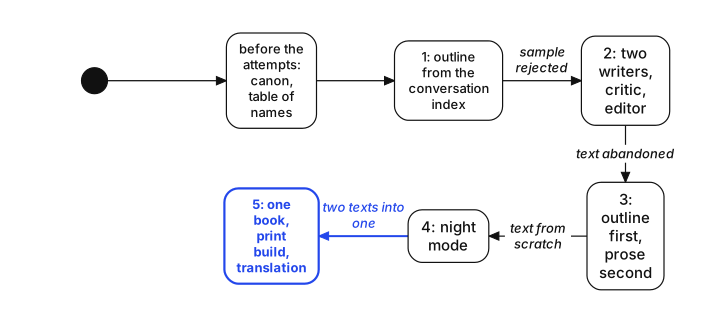
Each new attempt took over the rules, the tools and the canon, that is, the file of facts, from the one before. It did not take over the prose. The fifth is the exception: a review saved in the repository among the author's notes compared versions 1.0 and 2.32, and the author ordered one book in two parts to be made from them. Each time he decided the fate of the text in one sentence; the first of them came while the fourth attempt was already under way:
2026-10-01 20:45 AUTHOR: […] come on fix this, i want a new text, from the start completely, with a new map, we learn from mistakes and don't fix the previous one
2026-10-03 17:34 AUTHOR: create eksperyment-5, we'll be writing one book like in that review, add these texts as sources, add the canon, the facts we have, the whole output, get it?
2026-10-04 10:26 AUTHOR: let's not write thriller based on facts, that probably doesn't sell, let the output file not be called Volume 1, but Tell Me Yes and the version number, let's stick to that […]
Tell Me “Yes” is the book's third title. The author's decision on the title is dated 2 October – at that time it was the title of the first volume; the author decided on the file name on 4 October. “E2” in the first entry is the number of a question for the author in the decisions file, not the number of an experiment. Three entries from the history of the repository, each added by the author's assistant, that is, the model in the role abbreviated as ASY:
2026-10-02 10:32 COMMIT: [ASY] the author's decisions: E2 – title of volume 1 “Tell Me Yes”; pitch to be rewritten to YES2026-10-03 17:36 COMMIT: [ASY] experiment 5: one book “Tell Me ‘Yes’” (Pt I + Pt II) following the review […]; the whole output; E5 prompts […]; e4 closed2026-10-04 07:15 COMMIT: [ASY] build 3.11 after the night: the whole working draft (Pt I 34 ch., Pt II 43), md + html + PDF A5 221 pp.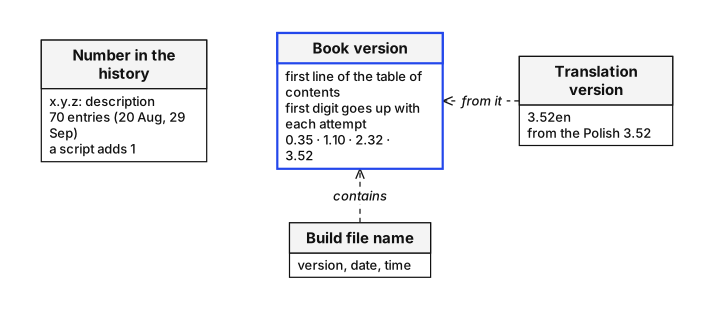
The oldest scheme appears in the commit subjects of 20 August and 29 September. Seventy subjects from that time begin with a three-part number and a colon; the last number was bumped by a script. The version of the book is set by the first line of the table of contents. Its first digit goes up with each attempt: the second ended at 0.35, the third at 1.10 (the edition that was listened to had the number 1.0), the fourth at 2.32, the fifth reached 3.52 on 5 October at 14:27. The translation carries the number of the Polish version it was made from, with “en” added. The name of the file with the built book, that is, the build, contains, among other things, the version, the date and the time. There is no version number in the text of the book.
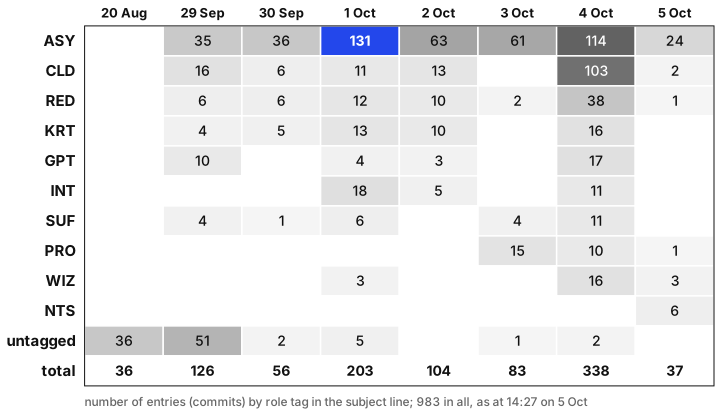
The role is shown by the abbreviation at the start of the commit subject. CLD and GPT are the two writers, Claude and ChatGPT; RED is the lead editor, KRT is the critic. The remaining abbreviations are explained in the next chapter. Every role is a language model. The largest number of entries, 338, falls on 4 October; that day the first line of the table of contents went through 47 different version numbers, from 3.1 to 3.49. The highlighted cell is the largest number of entries by one role in one day: 131, the assistant, 1 October. Almost half of all the entries, 464 of 983, were added by the assistant, which does not write prose. The number of commits measures activity in the repository, not the amount of text.