This part of the book was written by language models on a single instruction from the author. Here it is.
2026-10-05 14:25 AUTHOR: Third part of the book: about how it was made - based on the structure and history of the repository, treat the book as a PoC, there is to be created and described UML, BPMN diagrams and whatever others there may be, more diagramming than writing, max 100 pages, there can be references to BialyBrzeg.com. How much the human wrote and how much and from what the AI, facts, canon, skills, everything we have so far, a chat screenshot and chat fragments are a must - the cooperation of GPT and Claude etc. all the titbits, and what you are doing now has to be in it too. Go on, we'll see what comes of it, as usual I want the complete set - including the English version, manage until the product is reached.PoC is short for “proof of concept”: a trial run that is meant to show whether an idea can be carried out. UML and BPMN are two notations for drawing diagrams. A skill is a procedure saved in a file, which a model carries out step by step. The instruction was picked up by the assistant (ASY), the model that runs the team and talks to the author – a Claude model. The book is kept in a repository, that is, in a directory of files with a full history of changes. One entry in that history is called a commit; it has a timestamp and a subject, and the subject begins with the abbreviation of the role. At 14:27 the assistant added such an entry – one for the two orders the author sent at 14:25: about Part III and about the stops. A stop (“postój” in Polish, hence the file name POSTOJE.md), in the team's language, is a place where the reader breaks off reading because they do not understand something; a divergence is a place where the translation deliberately departs from the Polish text.
2026-10-05 14:27 COMMIT: [ASY] register of stops and divergences: POSTOJE.md (format, use, change of process) […]; the author's decisions of 13:58 and 14:25 (the reader must not stop; Part III)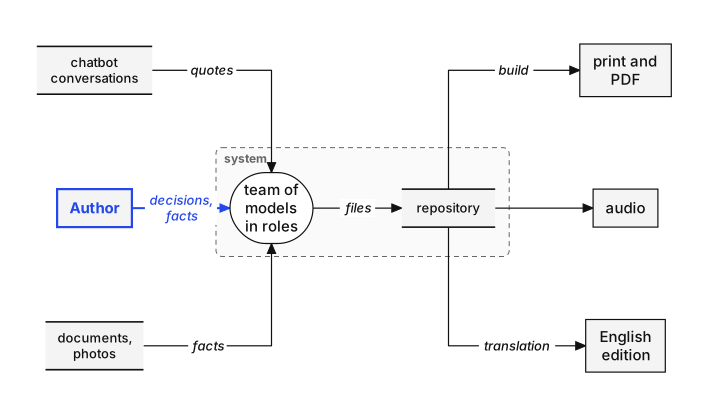
Three things go into the system: the logs of the conversations with the chatbot, known from Parts I and II; documents and photographs; and the author himself. The author does not write to the files. He dictates decisions and facts, and gives the go-ahead for work to start with the word “go”. The team consists of separate sessions of language models, each in one role. The sessions do not talk to each other directly; they communicate through files in the repository. Out of the repository come editions: a print file, a recording read by text-to-speech voices and the English translation.
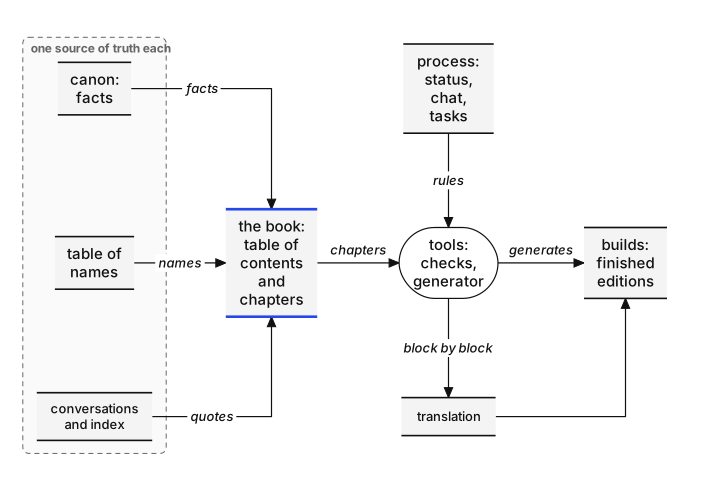
Every kind of knowledge has one place. Facts about events and people are held in one file, called the canon. The names under which people appear in the book are held in one table. Quotes come from the conversation logs. Alongside the text is the record of the work: whose move it is now, what the roles have handed over to each other, what is left to do. The tools are scripts. They check the chapters and build the finished edition out of them; the resulting file is called the build here.
The author keeps a public diary under a pseudonym at bialybrzeg.com. On 5 October 2026 the home page carried the sentences: “A book was made from this record.” and “A new entry on Mondays, Wednesdays and Fridays.”
The author ordered a chat screenshot. The chat windows in this part are reconstructions: every line is copied word for word from a file or from the record of a session, and “[…]” marks a cut; a word in square brackets replaces a word from the record. Five minutes after the instruction the assistant wrote to the author:
2026-10-05 14:30 ASY: I can't take a real screenshot of the chat window myself. I can put chat fragments together as a reconstructed window, labelled as a reconstruction – or insert a screenshot that you take yourself