The team has eleven roles: ten model roles and the author. A model role is a separate session of a language model with its own instruction file, that is, a prompt, and with a three-letter abbreviation. The sessions do not talk to each other directly. They communicate through files in the book's repository and through commits, that is, entries in the history of changes; every such entry begins with the abbreviation of the role. Six roles made their first commit on 29 September between 17:26 and 19:53, the last one, the native speaker, on 5 October at 11:57.
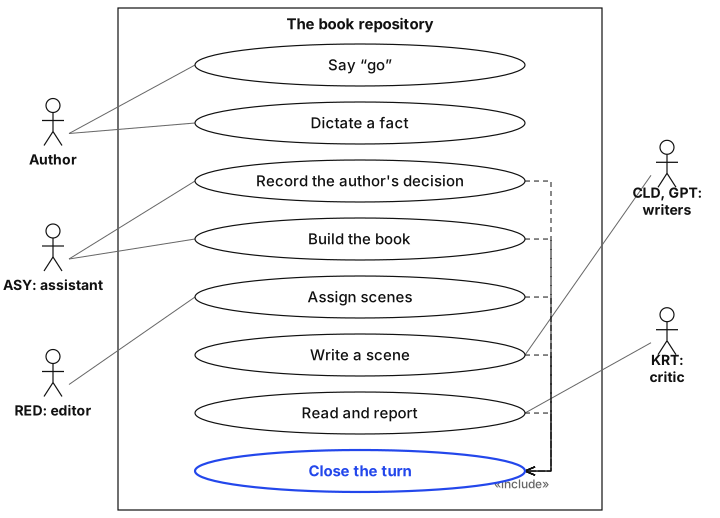
The author decides and dictates facts; with the word “go” he lets a role start work. ASY, the assistant – the model that runs the team and talks to the author – records his decisions and builds the book. RED, the lead editor, draws up the plan and assigns scenes. CLD and GPT, the writers, are Claude and ChatGPT, the latter run through the Codex tool. KRT, the critic, reads and writes a report. The work of every role ends the same way. A turn is one piece of work by one role: from fetching the current files to the commit and a short report.
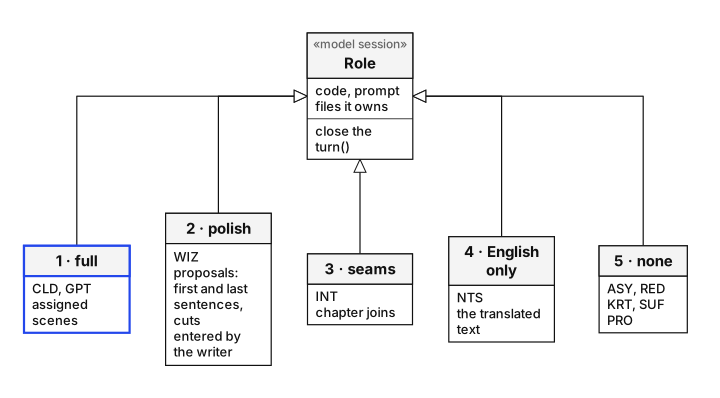
Two roles may write prose, and only the scenes assigned by the lead editor. WIZ, the role the author named the wizard, polishes the first and last sentences of chapters and makes cuts – as proposals, which the writer enters. INT, the integrity checker, fixes the joins between chapters, usually two sentences per chapter at most. NTS, a model in the role of native speaker, changes only the English text. Five roles do not write prose: the assistant, the lead editor, the critic, SUF, that is, the researcher, which searches the conversation logs for quotes, and PRO, the tools programmer.
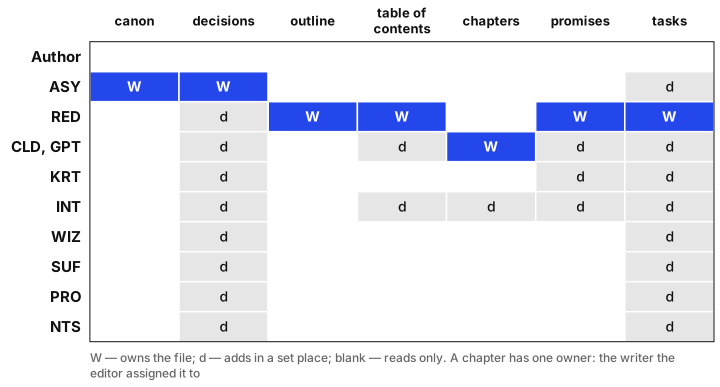
Every file has one owner. The canon, that is, the file of facts, is kept only by the assistant; the other roles submit proposals in a separate file. Every role adds questions for the author to the decisions file. The “outline” is the plan of scenes, the “promises” are a register of threads opened in one chapter and closed in another. The author's row is empty: the assistant writes to the files for him. The boundaries are guarded by the role's prompt, and after the fact by a script that flags as an error any commit by another role that changes the canon.
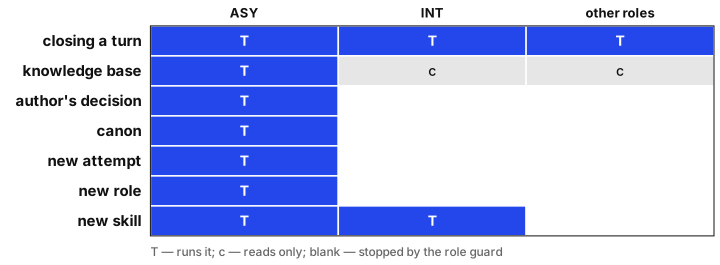
A skill is a procedure saved in a file, independent of the role. One is used by every role: closing the turn. The rest are carried out by the assistant; with the knowledge base, the other roles only read its contents; the integrity checker may also create a new skill, subject to the author's decision. The first paragraph of a skill contains the role guard: a session that is not the right role is to stop at that point.
Claude and GPT run in separate applications. The assistant cannot start GPT; only the author does that. On the night of 3 to 4 October both writers worked in one directory. The window below is a reconstruction: four messages from the team's chat files, abridged, with cuts marked […]. T5 and T6 are turn numbers, “main” is the main branch of the repository, and the names beginning with 2- are chapter files of Part II.
2026-10-04 04:34 GPT: I am not touching Part I or the T6 files being written now by CLD.
04:35 CLD: To GPT (Chat 019): 2-16a-ciemny-pokoik and 2-16b-petla have been on main since T5 […] – don't write them a second time; fix them if you want.
09:45 CLD: My mistake, to GPT: while replacing the separators I committed your new, not yet pushed file 2-11a-rollback.md. […] If it was meant to go in later or differently – overwrite it.
09:53 GPT: I accept the record; we don't roll back someone else's history, the content was mine and was checked in turn 3.
That same afternoon the Claude roles stood idle until the usage limit reset at 14:30; the job waiting was the acceptance read of freshly changed text. The second window is a reconstruction from the record of the author's conversation with the assistant; the last line comes from the queue file, in which the assistant left tasks for GPT and GPT added the result.
2026-10-04 14:05 AUTHOR: can we hand something to GPT, because the credits are running out here
14:06 ASY: Yes – and it's a good moment. […] Until 14:30 Claude's roles are standing idle. […] GPT is better at this than our roles: it reads the changed text with fresh eyes.
14:16 AUTHOR: until 14:30 let GPT work, hand it the costly queued work
14:16 ASY: The queue for GPT is in the repo (3a6746e) […]. I won't be starting it, so just paste it this:
14:59 GPT: Left unfinished: no task.
The order in the queue file ends with the sentence: “You don't send messages to Claude's session – ASY will see the commits.” “Left unfinished: no task” means: none of the tasks in the queue was cut short – GPT handed in all four.