The facts this book rests on are kept in one file. The team calls it the canon. Each fact is one line with a tag: [P] confirmed by the author, [?] to be confirmed, [X] refuted. Two rules apply. A new fact goes into the canon first and only then into the text. A missing fact means a question to the author, never filling in the gap. On 5 October at 15:00 the canon had 413 lines; apart from the header, 270 of them carried the tag [P], 81 [?] and seven [X]; the rest are headings, spacing and notes without a tag.
- [P] Asked who in “The Medal” says “All right. Then one more candle. For my mother. If that's how it is.”, the author, 2026-10-05 13:58, word for word: “that's me saying it, it's quite important”.
- [?] the exam and the night of 7 October 2023 […]: the author, 2026-10-02 10:53: “I don't know which 3 million this is about” – he doesn't remember; the order of the exam […] stays unestablished, in the text “in the autumn”, with no day.The first line closes a question about one sentence in the chapter “The Medal”. The second, abridged, with cuts marked […], shows what happens when the author doesn't remember (the exam and the “3 million” are matters from Part I): the entry stays open, and the text says only as much as is known.
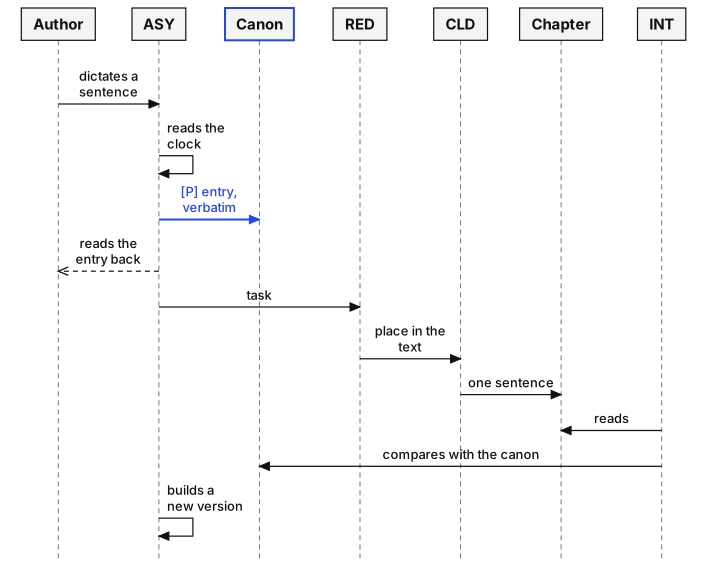
The author does not write to files. He dictates to the assistant (ASY), the model that runs the team and talks to the author; it records the sentence in the canon word for word, with the date and time it has read from the clock, and reads the entry back to the author. It may enter as [P] only what the author said outright. A place, a person or a date inferred from context gets [?] and a question. Only then does the lead editor (RED, a model) point to the place in the text, the writer (CLD, a model) adds the sentence, and the integrity checker (INT, a model) compares the chapter with the canon. When the author answers a role other than the assistant, that role records his words in a separate file of proposals; the assistant moves them into the canon. On 5 October one word went into “The Medal”: “mówię” – “I say”. The assistant entered it into the chapter itself, outside this path – in one commit, together with the entry in the canon:
2026-10-05 14:02 COMMIT: [ASY] 3.52 / 3.52en: “The Medal” – author: “that's me saying it” (canon, then text: “— Dobra — mówię.” / “— All right, I say.”); translation memory, build of both languages (text), report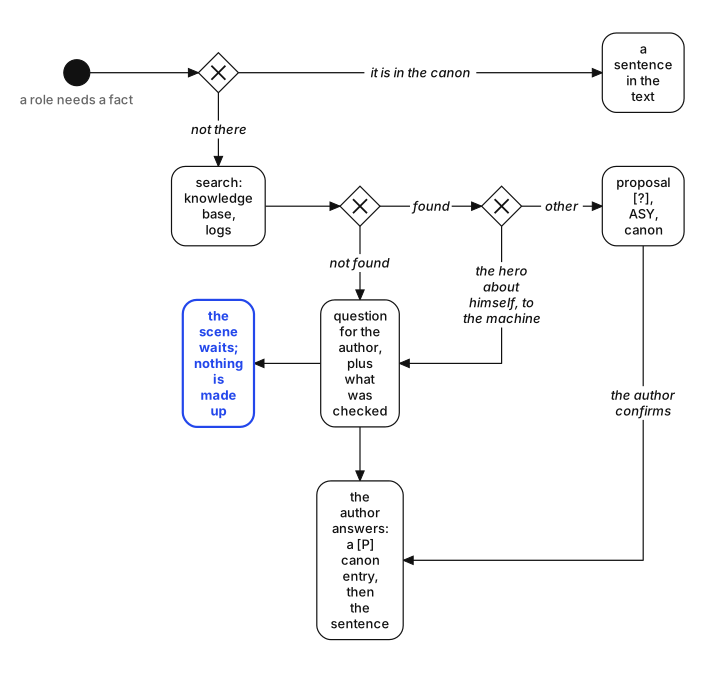
Since 1 October there has been a fixed sequence: before a question goes to the author, the role looks for the answer in the knowledge base, that is, in the collection of documents from outside the conversations, and in the logs, that is, in the records of the author's conversations with the chatbot. Something found in the logs is not yet a fact. When the hero – the author, as he appears in the book – tells the machine, that is, the chatbot, who he is or who is standing next to him, it may be a game played with the machine; the author decides. When there is nothing, the role records the question together with what it checked. The scene waits, or works around the unestablished detail.
On 4 October the writer refused the lead editor's request to add a sentence, and the integrity checker found in a chapter a sentence that was not in the conversation log. The window is a reconstruction: two independent messages from the team's files, abridged, with cuts marked […]. “Item 5” is the fifth item on the lead editor's list, “log 2848” is the number of a conversation log, and “T3” is the number of a turn; the commit's short hash is given in brackets.
2026-10-04 09:55 CLD: Item 5 not done – no fact in the canon […]. Needed: the author's word or a pointer to the log.
21:05 INT: in log 2848 […] there is no such sentence – it is a narrator's sentence added in turn T3 (339653e).
The sentence the checker pointed to was dropped from the chapter.
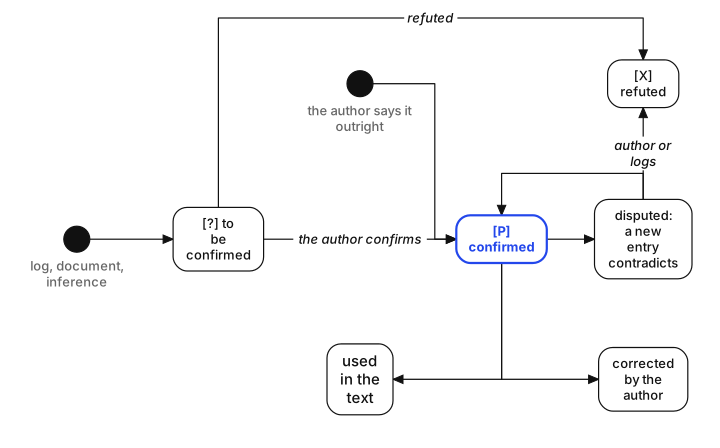
There are three tags, but an entry can be in more states than that. A confirmed fact becomes disputed when a new entry contradicts it. The old entry is not deleted then; the author or the logs decide. The author can also correct a fact: then the entry is corrected, and so is every chapter that rested on it. One arrow leads to the text, and it starts from the state [P].